



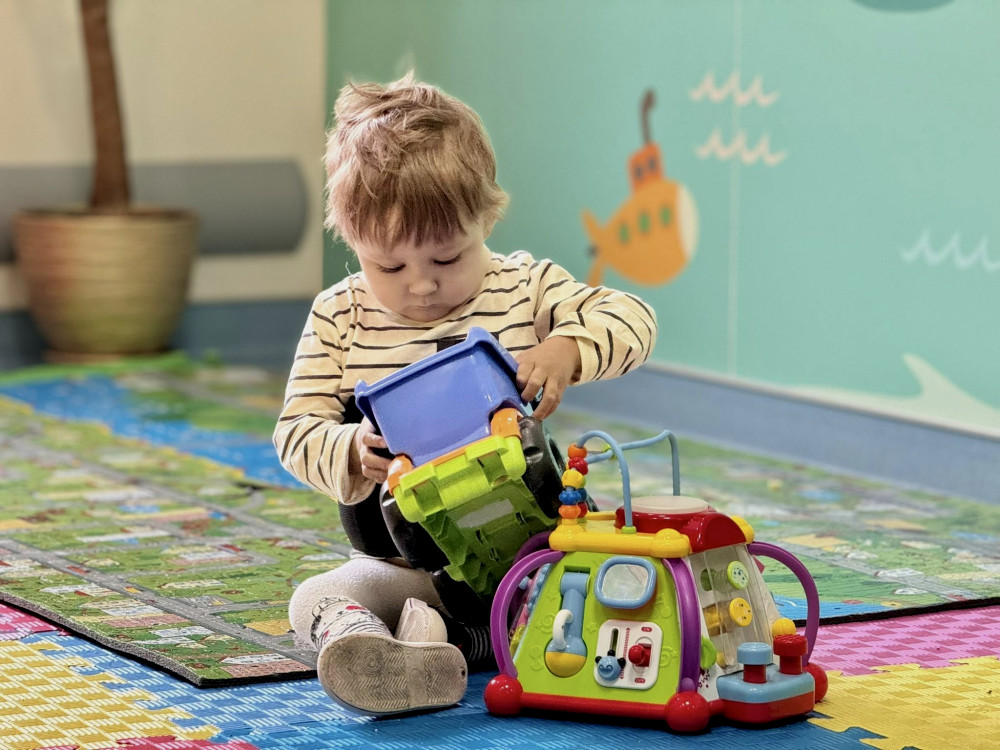
At the medical facility "Ohmatdyt", three-year-old Bohdan from Shepetivka was rescued from a serious congenital condition – he was born without bile ducts.
Only a liver transplant could save the child. The organ was donated by his father, as reported by "Ohmatdyt" representatives.
From the very first days of his life, Bohdan's parents noticed that his skin had an unnatural yellow tint. The local maternity hospital informed them that it was physiological jaundice that would resolve over time. However, three months later, the issue persisted.
After a visit to the cardio center in Kyiv, where the child was examined for a congenital heart defect, doctors suspected another cause for the jaundice, leading to Bohdan's hospitalization at "Ohmatdyt".
The doctors immediately noted the characteristic "greenish" jaundice and pale stool – classic signs of biliary atresia, meaning the absence of bile ducts.
The boy underwent an urgent operation, after which preparations for a liver transplant began.
"The child had a complex dual pathology: both liver and heart issues. We debated for a long time with the cardio center doctors on how to proceed because the risks were high in each case. Ultimately, we decided: first, the liver transplant, and then the cardiac surgery," said transplant surgeon Oleg Hodyk.
For the first year of his life, Bohdan essentially lived in the infectious disease unit for young children. Here, the medical team focused on nutrition, stabilizing his condition, and reducing toxicity. He took small steps towards the transplant, which they awaited for nearly three years.
"Bohdan practically grew up in our unit. There were constant hospitalizations. We did everything we could to ensure he reached this stage in the most stable condition possible," shared pediatrician Yulia Tkachenko.
Over the last year, the situation worsened: he began experiencing gastrointestinal bleeding, which became increasingly severe. A critical bleeding episode occurred during a flu infection. At that moment, the boy fell into a coma, but he was saved.
Following this, preparations for the transplant continued. The donor was the boy's father, Oleksandr. Initially, he was very anxious, but before the operation, he gathered his courage and said, "This is for my child – I can do this."
Thanks to the coordinated efforts of anesthesiologists, geneticists, hepatologists, pediatricians, surgeons, nurses, and other specialists, they were able to prepare the boy for the transplant and successfully perform the operation, which lasted over 13 hours.
Only a month has passed, but according to the parents, the changes are already noticeable.
"Before the transplant, he hardly reacted to anything. Now he eats cookies, plays with toys, runs around, and is more open to new people. We see progress, and that is the most important thing," shared his mother Maria.
A long period of rehabilitation, observation, and heart surgery lies ahead for him.
"But the most important thing is that he has received a chance at life," concluded the medical facility.